The Allure of Higo Kinko series 2 — The Shimizu School: A Lecture at the Naniwa Kodōgu Kenkyūkai
- gallery陽々youyou

- Dec 21, 2025
- 6 min read
Updated: Dec 22, 2025
At the Naniwa Kodōgu Kenkyūkai held in Osaka, a lecture on Higo kinko was delivered by Mitsuru Ito at Ikukunitama Shrine.Following the first chapter on the Hirata School, this second installment in The Allure of Higo Kinko series turns its focus to the Shimizu school.
In this four-part series—① Hirata, ② Shimizu, ③ Nishigaki, and ④ Hayashi & Kamiyoshi—we explore the distinctive aesthetics and characteristics of each lineage. The final series will revisit a small bidding-style kantei exercise conducted during the lecture. You are invited to approach it intuitively, as a way of sharpening the eye ♡
The Appeal of Higo Kinko
Each of the four principal schools of Higo kinko possesses a strong and individual character. In many traditions, close master–disciple relationships or shared regional backgrounds can lead to similarities in style. Yet Higo kinko works remain notably diverse, each school preserving its own artistic identity.
Rooted in the philosophy of samurai culture, works of Higo kinko range from finely controlled, meticulous to forms that feel almost abstract, reminiscent of modern art. The histories of these schools are relatively well documented, preserved through texts associated with the Kamiyoshi, Shimizu, and Hirata families, as well as records connected to the Hosokawa and Matsui families.
Another enduring appeal of Higo kinko lies in its abundance. A considerable number of works survive, making the field especially rewarding for collectors. From individual fittings to complete koshirae, the scope for appreciation is broad.


The Shimizu Family
Higo kinko is traditionally divided into four principal schools: Hirata, Shimizu, Nishigaki, and Hayashi. Among these, both Shimizu and Nishigaki trace their origins to Hirata Hikozō.
When Hosokawa Sansai entered Higo, they followed Sansai and settled in Yatsushiro. After Sansai’s death, both the Hirata and Nishigaki relocated to Kumamoto. However, the Shimizu only remained in Yatsushiro.
In “Works of Hirata & Shimizu” by Mitsuru Ito, a document preserved in the Matsui Bunko-—Omachikaisho Kokino-nashi kakinuki: Onjunken-sama O-tazune no O-kotae [An administrative document from recording responses given to official inspectors regarding local occupations and households.] (dated Kansei 1, 1789)—lists various professions, including “a single entry for a Shiroganeshi” (metal craftsman), identified as Shimizu Jingo. In addition, the name Shimizu Ginta appears in the corner of Fukuro-machi on the “Yatsushiro Castle Map”. This location corresponds exactly to the residence bestowed upon Hirata Hikozō by Hosokawa Sansai: Yatsushiro Fukuro-machi Higashi-kado yashikikuchi 29 ken 89 ku kado 3 shaku..
When my father was conducting research for his book some thirty years ago, descendants of Shimizu Jinbei were still living in Fukuro-machi, Yatsushiro City, Kumamoto prefecture. Remarkably, the address had remained unchanged since the Edo period. This year, I was able to visit the site myself with family and dearest friends [thank you for always indulging my curiosity]. Although the former “Shimizu Building” has since become the “Takahashi Building,” the white color building looked the same and we were able to see the trace of the building sign “Shimizu” under neath of “Takahashi”. The presence of Hirata Hikozō and Shimizu Jinbei still feels palpable.
To think that works of Shimizu were produced on this very ground through five generations, up to Shigenaga, is deeply stirring. About 100m (about 330 feet) away stands Iō-ji Temple, where a kōshin-tō [a stone monument associated with the Kōshin faith, erected to mark communal observances and prayers for protection and longevity.] still survives. On its reverse side, the names “Shimizu Jinbei Jō Kazuyuki” (志水仁兵衛尉一幸) and “Shimizu Sanjūrō Kazunari”(志水三十郎一也) remain clearly legible, dated Kanbun 12 (1672). Family memorial tablets confirm that Sanjūrō Kazunari was Jinbei’s younger brother, and that they lived together in the same household.


Shimizu Jinbei (First Generation)
Records titled “Senzobetsu” (a genealogical record listing ancestors and family lineage) preserved within the Shimizu family reveal that Jinbei used the name Kazuyuki; he did not use the name Jingo. A nephew of Hirata Hikozō, he lived alongside him in Fukuro town, Yatsushiro city.
After Hikozō’s death, and even after Hirata’s second generation, Shōsaburō, relocated to Kumamoto, Jinbei remained in Fukuro town. He passed away on May 27, 1675 (Enpō 3).
His work displays a strong and distinctive individuality. Surviving examples include iron tsuba with silver nunome-zōgan, brass suemon (an inlay method where brass motifs are placed onto the surface of the base material and secured, creating a raised decorative effect.), sukashi tsuba, and—more rarely—pieces in soft metals. All known works are unsigned.

Shimizu Jingorō (Second Generation)
The biological son of Jinbei, he was the first to use the name Jingo. Born in 1620 (Genna 6), he died on January 11, 1710 (Hōei 7) at the age of 91.
His works are primarily in iron and plain copper. Some resemble the late works of the first generation, while others feature elongated oval forms with raised earthen rims (dote-mimi). Silver nunome-zōgan is common; brass wire inlay is rare, and brass suemon has not been seen. All works are unsigned.

Shimizu Jingo Nagatsugu (Third Generation)
Born with the childhood name Kippei, he was the second to bear the name Jingo and also used the name Nagatsugu. As he was born when the second generation was already 71 years old, adoption is considered likely.
From the age of 16, he trained for 21 years under Nishigaki Kanshirō Nagahisa (second generation). Born in 1699 (Genroku 12), he died in 1777 (An’ei 6) at the age of 78.
Many signed works survive, and he continued signing “Jingo” (甚五) until at least the age of 72. In later years, he used the signature “Jingo” (甚吾) written differently, as well as “Nagatsugu,” though the majority of his works are unsigned. Tsuba bearing the “Jingo” (甚吾) signature feature distinctive round holes above and below the nakago-ana for sekigane.
His style is dominated by iron ground with silver nunome-zōgan, often in nagamaru-gata (elongated round forms). Some works incorporate large lateral openings, unconventional brass suemon, or are executed in plain copper. Celebrated as a master artisan, many of his works survive today.

Shimizu Jingo (Fourth Generation)
The third bearer of the name Jingo (甚吾), he was born in 1746 (Enpō 3) when Shimizu third generation, Nagatsugu, was 55. He died on July 20, 1823 (Bunsei 6) at the age of 78.
He signed works as “Yatsushiro Sandai-me Jingo saku” (八代三代目甚吾作). Many unsigned works also exist. His works produced before the age of 65 often bear small signatures and appear to be his own work, closely resembling the tasteful style of the third generation. Larger, more prominent signatures seen thereafter are believed to be substitute works signed by the fifth generation, Shigenaga reflecting a more modern aesthetic. Iron sukashi tsuba become more common in this period, while works in copper are rare.
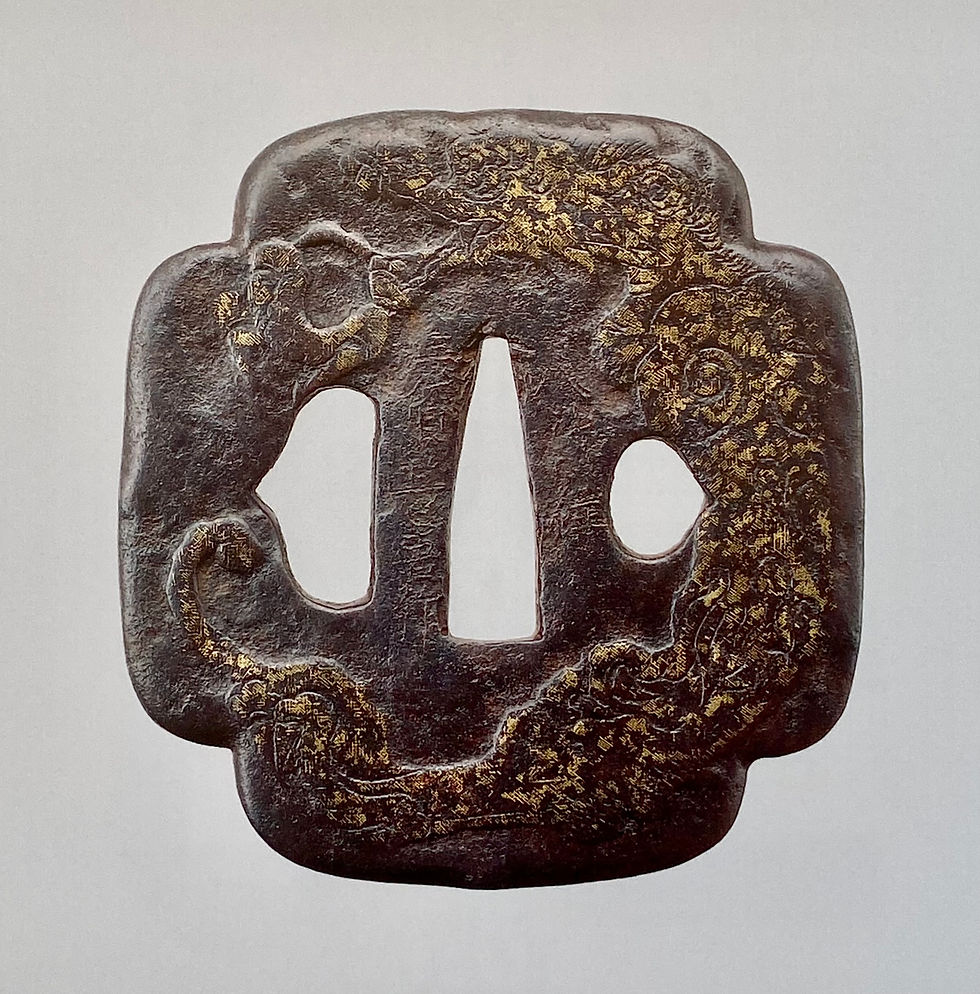
Shimizu Jingo Shigenaga (Fifth Generation)
The fourth bearer of the name Jingo, he used the name Shigenaga and died on May 13, 1854 (Kaei 7). He signed works as “Yatsushiro Jingo saku” (八代甚吾作) and “Yatsushiro Jingo saku Shigenaga” (八代甚吾作茂永). Some pieces include age inscriptions, while many remain unsigned.
Until the age of 70, his tsuba feature the distinctive round sekigane holes above and below the nakago-ana. A contemporary of Kamiyoshi Fukanobu, his work spans a remarkable range: sukashi tsuba, brass suemon, nunome-zōgan, irogane pieces, and fittings approaching the character of full kinko work.
Shigenaga trained many pupils, including Chisokutei and Ichiryūsai Chikatoshi. Highly esteemed as a master, his influence on late Edo-period Higo kinko was profound. Kumagai Yoshitsugu, often described as representing “Edo-Higo” in the Bakumatsu period, is also thought to have been among his pupils.

Closing thoughts:
At the Naniwa Kodōgu Kenkyūkai, Mitsuru Ito presented a comprehensive overview of the allure of Higo kinko. In this blog series, however, we step back from that overview and examine each of the four principal schools in turn.
This second series has focused on the Shimizu family. Founded by Shimizu Jinbei, nephew and pupil of Hirata Hikozō—the only Higo kinko known to have received direct guidance from Hosokawa Sansai—the Shimizu school flourished through five generations, producing a remarkable body of work. Within Higo kinko, It may be regarded as the most prolific and enduring of the four schools. Each generation expressed a distinct individuality, creating works rich in character and variety. With Hirata Hikozō as the teacher of both Shimizu Jinbei and Nishigaki Kanshirō, his influence resonates deeply throughout their work.
In the next blog, we turn to “The Allure of Higo Kinko series ③ — The Nishigaki School.” Until then stay tosogu & sword minded.
References:


Let us inbox you Samurai Newsletters! SIGN UP HERE!


Comments