The Allure of Higo Kinko series 1 — The Hirata School: A Lecture at the Naniwa Kodōgu Kenkyūkai
- gallery陽々youyou

- Dec 16, 2025
- 4 min read
Updated: Dec 18, 2025
At the Naniwa Kodōgu Kenkyūkai held in Osaka, a lecture on Higo kinko was delivered by Mitsuru Ito at Ikukunitama shrine. This post begins a series devoted to the aesthetic and characteristics of Higo kinko’s four main lineage, focusing first on the Hirata school.
To present the subject clearly and accessibly, each post in this series will concentrate on one of the four principal schools of Higo kinko:① Hirata, ② Shimizu, ③ Nishigaki, and ④ Hayashi & Kamiyoshi. Over four consecutive days, we will explore the distinctive aesthetics and characteristics of each lineage.
In the final chapter, the Hayashi & Kamiyoshi, we will also introduce a petit kantei exercises♡ also conducted during the lecture, inviting you to approach it as a game and test your eye.

What Is the Naniwa Kodōgu Kenkyūkai?
The Naniwa Kodōgu Kenkyūkai is a tosogu (sword fittings) study group founded in 1955 by Gofū Namba, a tosogu scholar from Okayama prefecture. At a time when accessible introductory materials—especially for the study of tsuba—were scarce. In response, the group complied “Tetsu Tsuba Shotō Nyūmon-shō” (鉄鐔初等入門抄 An introductory manual to iron tsuba) in Showa 37 (1962), which served as a lecture text. The book presents a wide range of iron tsuba, including sukashi tsuba, Higo tsuba, Nobuie, Yamakichi, and others revealing how iron tsuba formed the core of early lectures and research.


The Appeal of Higo Kinko
Twenty years have passed since Mitsuru Ito published his first book on the Nishigaki school of Higo kinko. This was followed by two other volumes on Hirata & Shimizu, and later Hayashi & Kamiyoshi.
Over the years, we have been deeply moved to encounter copies so thoroughly read that their bindings have loosened. It has also been a great pleasure to witness the depth of engagement these works have inspired. Just as meaningful is the sense of fellowship among collectors who share knowledge, discoveries, and questions through these books. As the second generation, I hope to continue exploring the aesthetics of Higo kinko together with fellow enthusiasts, collectors and scholars.

The Four Principal Schools of Higo Kinko
Higo kinko is traditionally divided into four principal schools: Hirata, Shimizu, Nishigaki, and Hayashi. Each school developed a distinct identity.
While close regional ties and master–disciple relationships often lead to stylistic convergence, Higo kinko remains remarkably individual and produces works of striking characteristic and artistic depth. Rooted in samurai culture, their works range widely from disciplined refinement to forms that feel unexpectedly modern, even boldly abstract.
Wonderfully, their extensive historical documentations provided by the descendants which have been published in three volumes of Higo kinko book, the lineages and histories of these four principal schools of Higo kinko are relatively well established and recorded. Another distinguishing feature is abundance that a considerable number of works survive, allowing collectors to explore not only individual fittings but also complete koshirae.

We invite you to immerse yourself fully in the four principal schools of Higo kinko, guided by the lecture note.
The Hirata School
Hirata Hikozō (First Generation)
Through the publication of Hirata & Shimizu, my father had the opportunity to meet descendants of Hirata Hikozō. Access to genelogial chart, lineage records, and historical records clarified the Hirata lineage from its origins to the present day, including dates of death, Buddhist names, and family ties.
These findings are discussed in “Works of Hayashi & Kamiyoshi “ (page.78).Although Hikozō’s year of birth is unknown, he is recorded as having died on November 9, 1635 (Kan’ei 12), at around 55 to 60 years of age. Hikozō along with his father, Matsumoto Inaba-no-kami, took part defending Tanabe Castle during the battle of Sekigahara.
Hikozō is believed to have begun producing fittings while residing in Buzen–Kokura. Under the command of Hosokawa Sansai, one of Sen no Rikyū’s seven disciples, he received formal training as a kinko and was later retained with a stipend of 100 koku.
It is this close relationship with Sansai that shaped Hikozō’s refined sensibility. Because of the direction and influence of Sansai, Hikozō is rightly regarded as the founder of Higo kinko. His works—both iron and irogane (soft metal)—reflect a cultivated aesthetic marked by restraint and intellectual depth. The irogane (soft metal) work, in particular, possesses a texture unique to Hikozō. Many examples feature symmetrical suhama-shaped hitsu-ana, and irogane tsuba often bear a distinctive punch mark on the seppadai. To date, only one signed iron tsuba by Hikozō is known, bearing the inscription “Hiko / Hikozō” (ひこ 彦三).
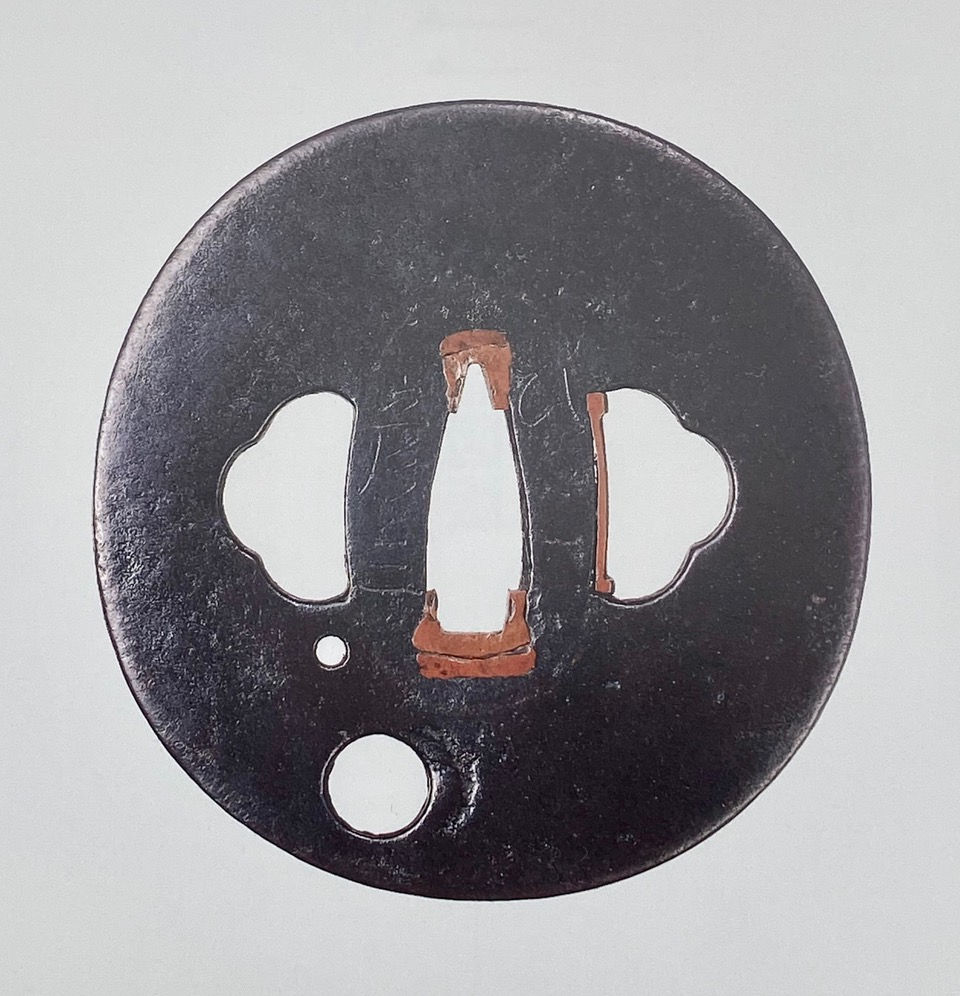
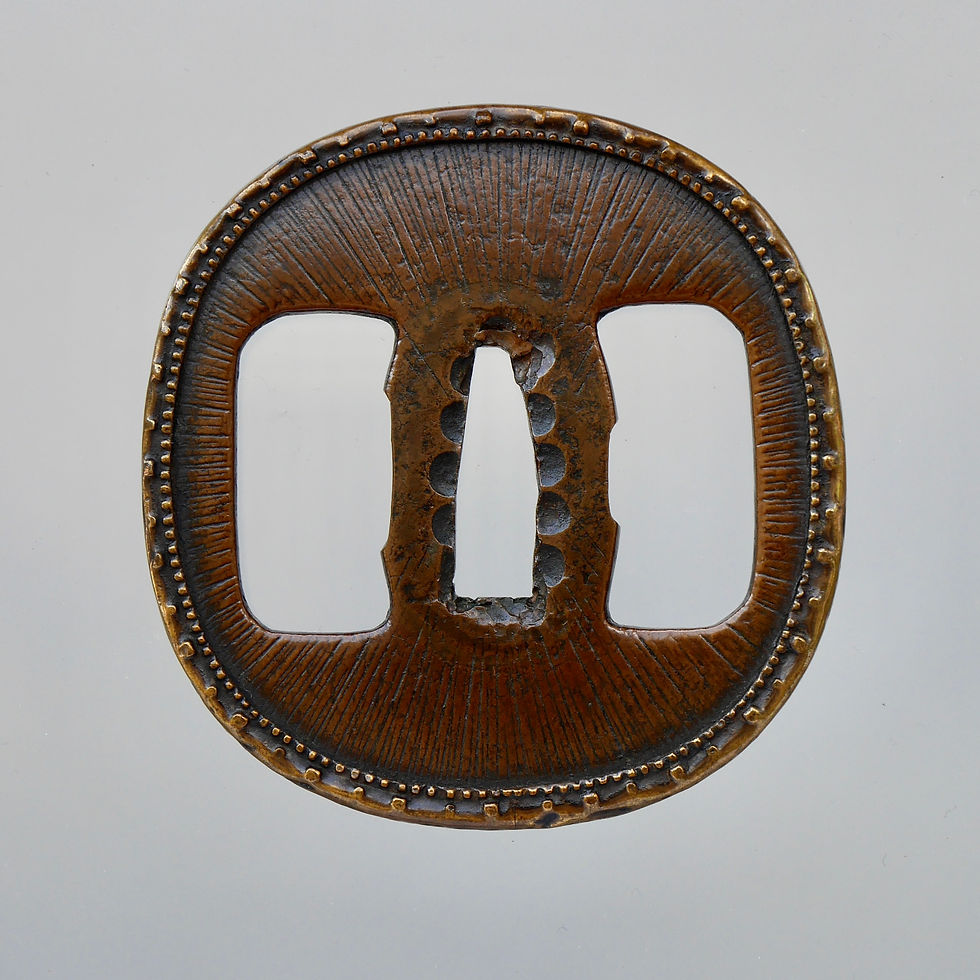
Hirata Shōzaburō (Second generation)
Hikozō’s eldest son was adopted out, and his second son, Shōzaburō, succeeded the family line. Born in 1618 (Genna 4), he passed away on March 24, 1686 (Jōkyō 3) at the age of 68.
After Hikozō’s death, Shōzaburō was summoned to Kumamoto and retained under generous terms, receiving provisions equivalent to 10 retainers and a stipend of 20 koku.
His works include both iron and soft metal works. While maintaining respect for the first generation’s style, Shōzaburō adapted his style to the preference of the period, favoring simpler compositions, brighter polished surfaces, and frequent use of plain fukurin. No signed works by Shōzaburō have been known today; all surviving examples are unsigned.

Closing thoughts
At the Naniwa Kodōgu Kenkyūkai, Mitsuru Ito presented a comprehensive overview of the allure of Higo kinko. In this series, we step back from that overview and linger with each of the four principal schools, allowing their individual character to come into focus.
This first series has centered on the Hirata School. Hirata Hikozō is the only Higo kinko known to have received direct guidance from Hosokawa Sansai, and it is said that tea utensils bestowed by Sansai were preserved within the Hirata family. As the teacher of Shimizu Jinbei and Nishigaki Kanshirō, Hikozō shaped the foundations upon which later generations of Higo kinko would build.
In the next chapter, we turn to “The Allure of Higo Kinko series② — The Shimizu School.” Until then stay tosogu & sword minded.
References:


Tetsu Tsuba Shotō Nyūmon-shō Nanba Gofu, Naniwa Kodōgu Kenkyūkai
Let us inbox you Samurai Newsletters! SIGN UP HERE!


Comments